
March 9, 2019
Forced to Turn on the Ghost Light


March 2, 2019
Getting Reacquainted with "Boesman and Lena" and "By the Way, Meet Vera Stark"
I recently had both experiences when I saw
revivals of Athol Fugard’s Boesman and Lena and Lynn Nottage’s By the Way, Meet
Vera Stark, each of which recently opened at Signature Theatre, the company that has made
a name for itself by restaging the work of significant playwrights.
Signature’s relationship with Fugard dates back to the
2011-2012 season when it presented three of the South African playwright’s
works and the company has continued to do a Fugard play at least every other
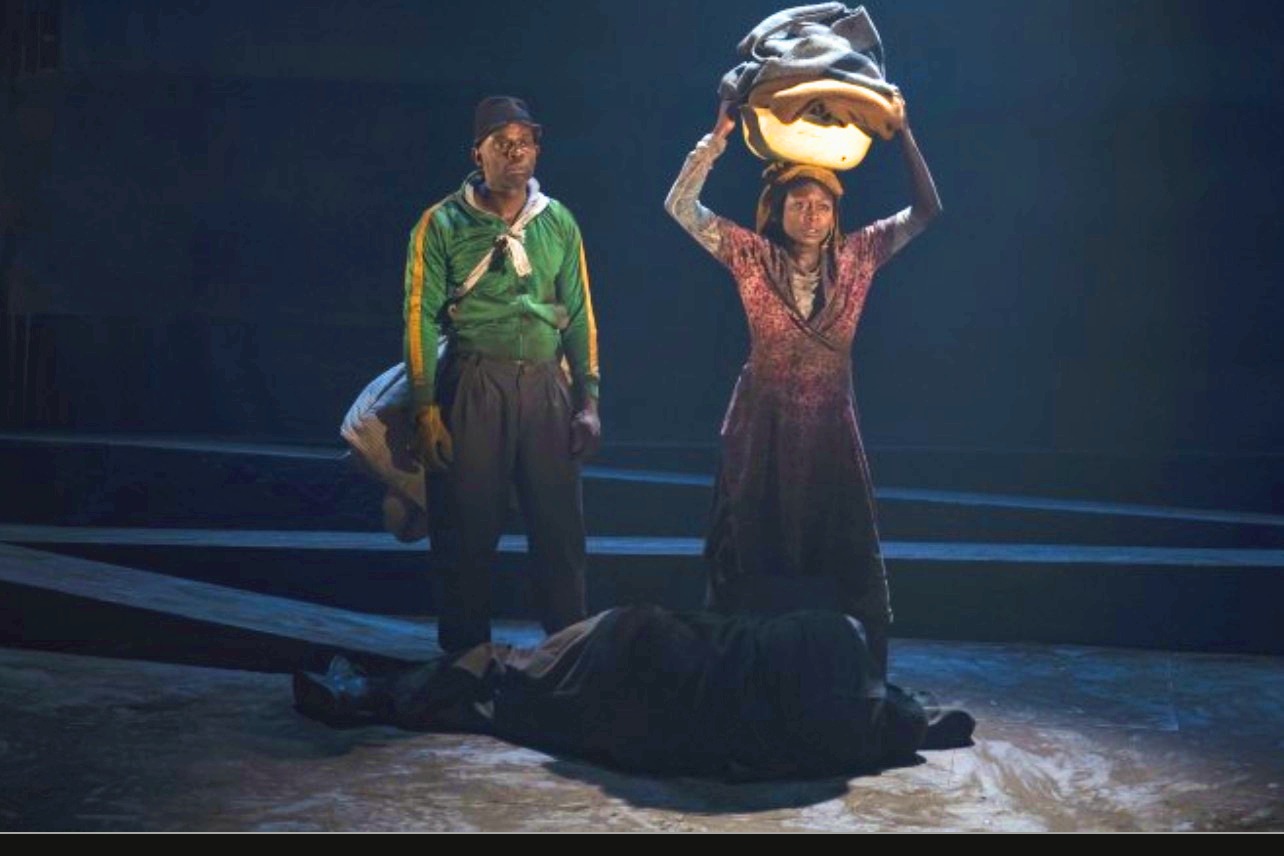
year since then. Boesman and Lena, which was originally performed at a South African
university in 1969, focuses on two days in the lives of a couple, categorized
as “coloured” under South Africa’s apartheid system, who become refugees in
their own land when government forces destroy the shanty town in which they
lived.
A young me first saw Boesman and Lena when James Earl Jones
and Ruby Dee played the eponymous couple in a 1970 production down at the old Circle
in the Square. It’s one of those theatrical memories I’ve long considered
sacrosanct. And yet I bought a tcket as soon as I heard that Signature had cast the dynamic actors Sahr Ngaujah and
Zainab Jah in its production.
Ngaujah first caught my attention 10 years ago with his high-voltage
performance as the Nigerian musician and activist Fela Kuti in the musical
Fela! And I found myself mesmerized by Jah when I first saw her as a ferocious rebel
fighter in Eclipsed, Danai Gurira’s 2015 play about the civil wars in Liberia.
Neither actor disappointed me this time around either.
Director Yaël Farber’s production of Boesman and Lena opens
with the weary couple trudging through the audience to the mournful sound of
the clanging pots that are among their few remaining possessions. Lena’s ceaseless
chatter—questions about where they will spend the night, complaints about the
beating Boesman gave her that morning and musings about how her life has come
to this point—provide the energy she needs to keep going. Boesman’s sullen
silence underscores his desperate—and potentially dangerous—hopelessness.
The situation becomes even more volatile when they come
across an ailing old Xhosa man and argue over whether they should take him into
the makeshift camp they’ve set up on some barren mud flats along a river.
Jah is a joy to watch as she moves effortlessly from the puckishness of taunting Boesman to the pathos of comforting the old man to the friskiness of the improvised dance Lena breaks into when she needs to rally her spirits. Ngaujah is given a more limited palette to work with but he digs deep, revealing the intense sadness of a man so crushed by racism that the only relief he can find is to lash out at others.
Jah is a joy to watch as she moves effortlessly from the puckishness of taunting Boesman to the pathos of comforting the old man to the friskiness of the improvised dance Lena breaks into when she needs to rally her spirits. Ngaujah is given a more limited palette to work with but he digs deep, revealing the intense sadness of a man so crushed by racism that the only relief he can find is to lash out at others.
Farber, herself South African, emphasizes the bleakness of
these character’s lives with an intentionally hermetic production that eliminates the intermission and doesn’t even
allow the actors to take a formal curtain call.
Some people I know have harrumphed that her approach is too unrelentingly grim but I think it perfectly captures the anguish that millions of refugees around the world continue to experience and to salute the resolve that allows them to persevere.
Some people I know have harrumphed that her approach is too unrelentingly grim but I think it perfectly captures the anguish that millions of refugees around the world continue to experience and to salute the resolve that allows them to persevere.
This revival doesn’t surpass or erase
my memory of Jones, Dee and the great Zakes Mokae as the old man but it does give the show a new and urgent relevance.
Nottage, a double Pulitzer Prize winner, is in the middle of
her inaugural season at Signature, which she has so far devoted to her more
comedic plays (click here to read her feelings about that). By The Way, Meet
Vera Stark is her satirical look at the way Hollywood has treated black women.

The play's 2011 production at Second Stage featured a top-shelf
cast that included Sanaa Lathan as Vera, Stephanie J. Block as the temperamental white movie
star Vera works for and Karen Olivio as Vera’s friend who can and does pass for
Brazilian so that she can get roles denied black actresses.
The current cast—with Jessica Frances Dukes, Jenni Barber
and Carra Patterson assuming those roles—may be less starry but they’re equally game. The problem is in the direction. Jo Bonney directed the 2011
production with the same kind of brio that fueled so many Golden Age screwball
comedies.
Some of its scenes went over the top but, for the most part, they
brought the audience along with them. And they did it without sacrificing
the show's important message. For Nottage's play is simultaneously a comedy, a tragedy, a call to arms and, especially in its second act, structurally adventurous. I had some problems with that earlier production (click here to read my review) but I thought about the show for weeks after seeing it.
Kamilah Forbes, who directed the current production, has
a tougher time finding the right rhythm. At times the pacing is too fast and
jokes fly by before they can register. Other moments drag on, particularly a
few of the segments that use video. And some of the costume choices, especially
the dress Vera wears in the second act, try too hard.
My sister, who loves ‘30s movies, hadn’t seen the earlier
production of the show and so I invited her to this one. She struggled to stay
with it but eventually fell asleep.
“So what happened at the end?” she asked me as we walked down the block to the venerable West Bank Cafe for a quick post-show dinner. I started to tell her and then realized I’d already forgotten. Which kind of breaks my heart since remembering Vera is the whole point of the piece.
“So what happened at the end?” she asked me as we walked down the block to the venerable West Bank Cafe for a quick post-show dinner. I started to tell her and then realized I’d already forgotten. Which kind of breaks my heart since remembering Vera is the whole point of the piece.
February 23, 2019
Rolling Along with "Merrily We Roll Along"

My 40s were my favorite decade. I suspect that’s because
it’s when I got my dream job (editing the arts section of a major publication)
and met my dream guy (my still totally-adored K). But it was also because I
realized that I was old enough to learn from the mistakes I’d made but still
young enough to do something about them.
The characters introduced in the
opening scene of the musical Merrily We Roll Along aren’t so lucky. But the
ruefulness that accompanies them in their journeys from idealism to resignation
has made this show one of Stephen Sondheim’s most admired and it’s never tugged
at my heartstrings more than it does in the Fiasco Theater’s revival, which
opened at the Roundabout Theatre Company’s Laura Pels Theatre this week.
Inspired by the identically-named 1934 play by George S. Kaufman and Moss
Hart, the musical chronicles the lives of three artists—a composer named Frank,
a lyricist and playwright named Charley and their novelist friend Mary—but it tells their stories in reverse order, with the earlier scenes showing the compromises
and disappointments the trio experience in middle age while the latter ones depicts the optimism of their youth.
The original 1981 production directed by Hal Prince famously
miscast teenagers to play all the roles and ran for only 16 performances. (Lonny
Price, who played Charley in that production, recently made a terrific documentary
about it called “Best Worst Thing That Ever Could Have Happened,” which
you can find by clicking here).
Noah Brody, Fiasco’s co-artistic director (click here to read more about him and his approach) has cast age-appropriate members from his troupe in this revisal (the playbill says
Sondheim endorsed the trimming of the late Furth’s book to just 105 intermission-less minutes and
the reassigning of some songs). But Brody's casting choices also have their plusses and minuses.
Six people play all the roles, compared to the two dozen in
the Prince production. And on the up side, those actors, many of whom have been collaborating since their college days at Brown
University, put to good use the comfortable familiarity and knowing frustrations that
come from their own long association.
They're also clever at integrating into their stagecraft the Fiasco
trademarks of inventive stage business (in one delightful sequence mannequins fill in for the
missing ensemble) and quick costume changes. But here's a significient negative: their vocal strengths vary from impressive (Manu Narayan in the
role of the uncompromising Charley) to not-all-that-great.
And not everyone is rolling along with this Merrily. A group of my theater-savvy friends and I had
a great debate about it via email last weekend, with me in the minority.
Still, George Furth’s book, a series of significant moments spread across the
decades of the friends’ lives; and Sondheim’s score, filled with both amusing patter songs
and gorgeous ballads, ring with the doubts and insecurities familiar to all of us for whom our 40s are now just a memory.
And as I sat watching Merrily and thinking back over the people who have moved into and out of my life over the past few decades, the show’s wistful anthem “Old Friends” has never sounded more poignant.
And as I sat watching Merrily and thinking back over the people who have moved into and out of my life over the past few decades, the show’s wistful anthem “Old Friends” has never sounded more poignant.
February 16, 2019
Celebrating a Dozen Years of B&Me

As longtime readers know, I started this blog on Feb. 14,
2007, and so every year, I get to observe Valentine’s Day by celebrating the big
loves of my life: my husband K (we had a great dinner at one of our favorite restaurants,
although I may have overindulged on the Cosmopolitans) and seeing theater and
writing about it here. So I’m taking time out to toast 12 years of
doing the latter.
The last 12 months have been really great. I saw some terrific shows and I got
to talk to several of the playwrights who created them for the “Stagecraft”
podcast I do for BroadwayRadio (you can check out those interviews by clicking here).
And I got to talk to other theater makers for stories I wrote for
American Theatre magazine (click here to read that piece) Broadway News (click here for this one) and TDFStages (click here for it).
I also had the honor of being elected to the executive
committee of the Outer Critics Circle and to the American Theatre Critics
Association, for whom I moderated a panel at last fall’s New York conference
whose timely theme was “Beyond Straight White Men: Diversity on Page and Stage.”
But all of that began here, with this blog. And I am so grateful to those of you who've been reading these posts over the past dozen
years and to those of you who might be visiting for the first time today.
My
calendar is already filling up with all kinds of promising shows and I hope all
of you will stick around so that I look can share my thoughts about them with you
in the coming year. In the meantime, a belated Happy Valentine's Day and, of
course, happy theatergoing too.
Subscribe to:
Posts (Atom)