Showing posts with label covid. Show all posts

December 18, 2021

Sizing Up An Uneven and Uneasy Fall Season


You might have thought that I’d given up on theatergoing if you’ve been checking in here to see what I had to say about this comeback season’s new shows only to discover that I’d written about just three of the productions that have opened over the past four months. It’s not that I haven’t been going. 

Despite my trepidations about the coronavirus and its variants, I got my booster shot, double-masked myself, hung a mini air-purifier around my neck (the latter probably doesn’t offer much protection but it’s been a nice emotional palliative) and ventured out to a theater about twice a week. The problem is that, with a couple of exceptions, I haven’t really enjoyed most of what I’ve seen and who wants to naysay theater at a time like this when it’s scrambling to stay on its feet. 

I don’t know if my lack of enthusiasm reflects my uneasiness about sitting in a closed space with a bunch of strangers, even if they do have to show proof of having been vaccinated and are required to remain masked throughout the performance. Or if it’s because producers have been saving the really good stuff for the spring season when, they assumed, the virus would be controlled and we’d all be back to normal.

Either way, the most recent shows I’ve seen— Morning Sun, Kimberly Akimbo and Company—have offered a mixed bag of experiences. Here are some brief thoughts about each of them:

MORNING SUN:  From the first moment I even heard about Manhattan Theatre Club’s production of British playwright Simon Stephens’ latest work I knew I wanted to see it because its cast consisted of the powerhouse actresses Edie Falco, Marin Ireland and Blair Brown. And I wasn’t disappointed. All three, under the sensitive direction of Lila Neugebauer, give moving performances in this portrait of a working-class woman who in the final moments of her life looks back at the good and bad choices she made. 

Until recently the lives of women were mainly celebrated when they were royal, rich or the sexual objects of men's desire and some critics—mostly male ones—dismissed this everywoman story as not worthy of being dramatized. But Stephens’ determination to show that even the most mundane lives matter spoke to me. I wish I had seen this one earlier so that I could have urged you to see it. Instead, its run ends tomorrow.


KIMBERLY AKIMBO.  David Lindsay-Abaire’s dark comedy debuted back in 2003 but now he’s teamed up with composer Jeanine Tesori to create a musical version of it. The title character in both incarnations is a girl with a genetic condition that causes her to physically age at a rapid rate so that by the time she’s in her teens, she resembles a woman way past menopause and is facing the prospect of a premature death. The people in her life include her alcoholic father, narcissistic mother and a nerdy boy at school who becomes her lifeline. 

I have to admit that I found myself wishing I’d seen the original because the show doesn’t really seem to need music. Luckily, Victoria Clark is on hand to lend her gorgeous voice to Kimberly’s songs and an unsentimental poignancy to her story. A fresh-faced newcomer named Justin Cooley also brings a sweet charm to her boy friend. So in the end, I had a good time and I suspect you might too. The run has already been extended to Jan. 15 and there’s talk of a move to Broadway.


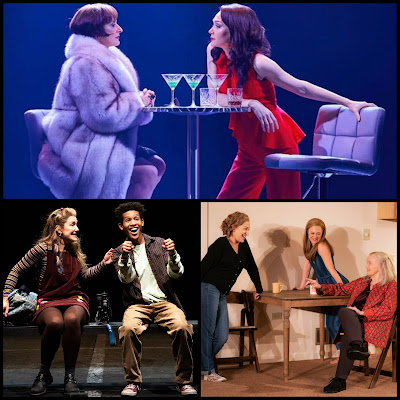
COMPANY: One of the most high-profile productions of the season even before Stephen Sondheim’s death last month, this revival of his genre-redefining show that established the concept musical turned out to be the biggest disappointment for me. Perhaps that’s because I originally had such high hopes for it. 

Unlike so many revivals that are done simply because a big name wants a crack at a classic part or producers feel they can cash in on a title already familiar to ticket buyers, this one had a mission: director Marianne Elliott wanted to upend Sondheim and book writer George Furth’s exploration of the romantic life of an unmarried guy turning 35 by recasting that role as a woman. 

That, of course, meant other changes too. Some work (the couple getting married in the show-stopping number “Getting Married Today” are now both men) but some really don’t (the older woman friend who propositioned the male Bobby in the original, now tries to pimp her husband out to the female Bobbie). 

But the biggest glitch is the revival’s star Katrina Lenk, who was wonderful in Indecent and won a Tony for playing the world-weary tavern owner in The Band’s Visit. Here, perhaps to fit in with Elliott’s concept of Bobbie as a kind of Alice in Nightmare Wonderland, she plays Bobbie as a wide-eyed naïf, which seems wrong for the role. Also neither her vocal chops nor vocal interpretation are up to the demands of such bittersweetly nuanced songs as “Marry Me a Little” and “Being Alive.” 

The audience the night my theatergoing buddy Bill and I saw the show didn’t care about any of that. People cheered as soon as the lights went down and they went crazy when Patti LuPone, stepping into the role of the older woman friend made famous by Elaine Stritch, sang “The Ladies Who Lunch.” 

I also appreciated the way LuPone made the song her own and a few of the other performances too (talking about you Claybourne Elder as one of Bobbie’s meathead beaus and you Matt Doyle as the reluctant bridegroom). 

But my favorite part of the evening was the usher who quietly patrolled the aisles throughout the performance, reminding mask scofflaws to pull their masks up over their noses, more important than ever when covid outbreaks in their casts or crews are forcing more and more shows to cancel performances. At least nine, including the Radio City Music Hall Christmas Spectacular, have had to go dark for part or all of this pre-Christmas weekend. These are indeed uneasy times for us all...


October 9, 2021

Going Back to "Pass Over"—and live theater


I went to see a show this week.  There was a time when that wouldn’t have been a remarkable statement. I routinely saw 150 shows a year and shared my thoughts about many of them here. But, of course, that was in the before time: before the global Covid pandemic struck, before it killed some 700,000 people in this country and a total of 4.5 million around the world, before the threat of even more infections, hospitalizations and deaths shut down theaters everywhere.  

My husband K and I have social distanced aggressively during the past 19 months, venturing out only for occasional grocery trips and for two memorial services, neither of the deaths caused by the virus. We stayed cautious even last spring when we got vaccinated and at the beginning of this past summer when it looked as though the worst might be behind us and some live performances began popping up. My theatergoing buddy Bill and I even tried one of those outdoor productions. But then, the more insidious delta variant arrived and I scurried back into hibernation, where I tried to scratch my theater itch with productions streamed online.

But over the past month, a dozen shows have opened in Broadway theaters, including such warhorses as Wicked and The Lion King and newbies like Six, which had been scheduled to open March 12, 2020, the night the pandemic forced the lights to go out on Broadway. There have been openings at smaller theaters around the city too. And more are scheduled for the rest of the year.  

There have been some setbacks. Aladdin had to close down for 10 days after the virus insinuated its way through that company. But rigorous testing of cast and crew members, along with additional safety protocols have kept other shows going (click here to read about some of those measures). 

Meanwhile producers and theater owners have tried to woo theatergoers back with such anti-virus protections as limiting entry only to those who show proof of vaccination or negative results from recent testing, insisting on the wearing of masks throughout performances and, in some cases, installing high-powered air purification systems.

Many of my friends jumped at the chance to return. They reported back about tearing up as they walked back into theaters for the first time, cheering the pre-show announcements and joining extended standing ovations.  Finally, nervously, I’ve joined them. 

I went to see Pass Over, before its short seven-week run at the August Wilson Theatre closes this weekend. It's one of the many works by black playwrights scheduled for this fall season, an acknowledgment of the racial reckoning in the theater community and elsewhere in the aftermath of the murder of George Floyd. 

Antoinette Chinonye Nwandu’s response to the massacre of black men by white law enforcement officials across the country is also an audacious riff on Waiting for Godot. She sets her play on an urban street corner, populated by a single street lamp and two young black men named Kitch and Moses who, like Vladimir and Estragon in Samuel Beckett’s original, dream of getting off the block but are unable to figure out how to do it. 

Two white characters show up.  One is a seeming do-gooder, dressed in a white suit and eager to share his lunch with Kitch and Moses. The other is a cop, wearing reflector sunglasses and carrying a billy club, who’s determined to humiliate them. The fact that the white men are played by the same actor underscores Nwandu’s message of white duplicity.

At moments during the play, Moses and Kitch are literally paralyzed with fear of what the cops, or po-pos as they call them, can do to black men like them. And yet, like Godot, Pass Over manages to balance both humor and despair.  

I’d seen the show when it played at LCT3 in 2018 and I was knocked out by it. The excellent cast here remains the same as then with John Michael Hill as Moses, Namir Smallwood as Kitch (although understudy Julian Robertson performed at my matinee) and Gabriel Ebert as the white characters. 

But Nwandu, explaining that she no longer wanted to dwell on black pain, has since crafted a different ending for the Broadway production (click here to read more about that). I sympathize with her desire to sidestep that brand of tragedy porn but I found the new ending to be awkward, pedantic and overly long.  

I missed the powerful ending that dared the audience, particularly the white audience, to confront how deeply systemic racism is ingrained in this country. But an earlier Chicago production with that devastating conclusion was preserved on film by Spike Lee and you can find it on Amazon Prime (click here to watch it). 

I know from recent experience, that streaming isn’t the best way to watch theater but like many theater lovers I remain wary of being in crowded indoor spaces (click here for some other views of that.) So I haven’t yet decided if I’m really ready to give up online viewing and return to live theater full-time.  As they say on TV, stay tuned.


March 11, 2021

A Theatrical Anniversary None of Us Wanted

A year ago today, I was gearing up for the intense out-every-night theatergoing of awards season and, as I told my friend David Gordon who has been publishing a chronicle of this past pandemic year on the Theatermania site (click here to read some of it), I had already scheduled tickets for more than two dozen plays over the coming five weeks and was busy setting up others. Yet, I was also a bit nervous about this strange new virus that seemed to be spreading rapidly. And I wasn’t the only anxious one. Everywhere I went, the scent of Purell hung heavy in the air and friends made uneasy jokes about how often we all were washing our hands. 

Still my theatergoing buddy Bill and I met up at the Greenwich House Theater in the Village to see a preview of the Ars Nova production of the now-ironically named Oratorio for Living Things. We showgoers were forced to wait in the lobby until right before curtain time and were then ushered into a small space that had been outfitted with temporary risers. I remember watching the 94-year-old critic William Wolf and his wife Lillian clamber up to their seats as I thought about what intrepid theater lovers they were. But my nervousness intensified when the show began because the performers meandered through the audience as they sang and I couldn’t help wondering if that were safe for any of us.  

That was the last time I was in a theater. Bill and I were supposed to go to Playwrights Horizons to see Unknown Soldier, the late Michael Friedman’s final work, the next night, March 12, but I called and told him I had become too uneasy to sit in a theater. Later that day, Broadway shut down, supposedly only for a month. Smaller theaters around the city quickly did the same. Two weeks later, Bill Wolf died from complications brought on by the virus. Over the past 12 months, the virus has killed more than half a million other Americans, nearly one out of ten of them New Yorkers. 

So the theaters have remained closed and the pandemic has devastated New York’s theater community. The playwright Terrence McNally died from the virus. The actors Mark Blum and Nick Cordero died. Danny Burstein almost died and then lost his wife Rebecca Luker. And thousands of people were put out of work—not only actors, musicians and designers but those that work in the shops that make costumes and props and in the restaurants and bars that theatergoers frequented after seeing shows. By some estimates, 50,000 theater-related jobs were lost.

But theater folks like Rosie O’Donnell and Seth Rudetsky rallied to the call, organizing online fundraisers for groups like The Actors Fund, which has distributed more than $20 million to some 15,000 people this past year. Others celebrated Stephen Sondheim’s 90th birthday with a star-studded concert that uplifted more than just that master of the musical.  And still others wrote and recorded monologues and mini-plays chronicling the toll of the epidemic or exploring the racial fissures in the country revealed by last summer’s brutal suffocation of George Floyd by a white cop whose murder trial began this week. 

As the weeks went by, the productions got more and more sophisticated. Some companies like the Mint Theater raided their archives and streamed previously recorded productions for free. Others like New York’s Irish Repertory Theatre, Chicago’s Steppenwolf and London’s Old Vic created entire digital seasons. There’s been a revival of audioplays. And the platform TikTok has even got into the act with a few group-created musicals. Some of it has been so-so; some of it has been great. My blogger pal Jonathan Mandell has assembled a list of some of the very best, which you can find my clicking here.

It’s still too soon to know when we’ll all be able to return in person to the theater again but the possibility seems closer. People, including Sondheim, are getting vaccinated. Joe Biden’s economic recovery package has passed, providing money for individuals and venues to keep going until everyone is back on their feet. 

And this week has brought the announcement that a few Broadway theaters will open in April for performances as part of the city’s NY PopsUp program, which is designed to bring live entertainment back to the city. Venues with flexible spaces that can accommodate distanced seating are scheduling productions for this spring. Commercial producers are predicting that Broadway may open its doors in the fall and tickets for touring shows have begun to go on sale. Meanwhile Tony voting is underway.  

I haven’t written much here over the past year but I have tried to keep up with events in a special magazine, Theater in the Season of the Coronavirus, that I set up on the Flipboard site and I hope you will check it out, which you can do by clicking here.  I hope, too, that by this time next year, we’ll all be back in our seats in our favorite theaters and perhaps, if the theater gods smile on us, we can even do it without needing to wear masks.