November 5, 2022

Life and Death Stories In "Everything's Fine," "Walking With Ghosts," "Where the Mountain Meets the Sea," and "My Broken Language"


The writer Joan Didion once said that “we tell ourselves stories in order to live.” But lately an increasing number of theater makers have not only been telling the stories of their lives but sharing them onstage. Over just the last three weeks I’ve seen four shows that look back at the lives of the people who created them and this week it was announced that Anthony Rapp, the original Mark in Rent, plans to bring a one-man show based on his 2006 memoir “Without You” to New World Stages in January.

It could be that producers like these shows because they tend to have small casts—sometimes just the one person—minimal scenery and almost no costume changes. But I suspect that the trend also has something to do with the fact that so many of us have gotten used to sharing our lives on Facebook and Instagram and TikTok. As Andy Warhol allegedly predicted, we’re all searching for our 15 minutes of fame. 

The challenge for the theatrical seekers is to make it clear why the rest of us should want to spend time with their stories and what those stories can tell us about our own lives. Here’s how four shows have fared at those tasks:

EVERYTHING'S FINE: Douglas McGrath got a Tony nomination for writing the book for the Carole King musical Beautiful and he earned an Oscar nomination for co-authoring the screenplay for the 1994 backstage comedy "Bullets Over Broadway" so he was no stranger to showbiz stories. Which made it somewhat surprising that his one-man show, which opened last month at the DR2 Theater in Union Square, focused on his Texas boyhood in the early 1970s. 

McGrath and his director John Lithgow (yes, that John Lithgow) allowed their narrative to meander a bit before they zeroed in on the 14-year-old Doug’s experience with a female history teacher in her 40s who became obsessed with him, left him notes, called him at home. The story didn’t go quite where you thought it would and the strained attempts to tie it into McGrath’s feelings about his late father left me wondering why I should care. 

And then, just as I was writing this post, came the news that McGrath, only 64, had suddenly died on Thursday night. In an interview he did last month with my BroadwayRadio colleague Matt Tamanini, (click here to hear it) McGrath said he didn’t want to hold onto the anger and bitterness he’d felt in the past and I’m sorry that it took his passing for me to grasp that message his show was trying to share with me.

WALKING WITH GHOSTS: The Irish actor Gabriel Byrne dips back into his childhood too in this one-man show based on the highly-praised memoir of the same name that he published last year. I haven’t read the book but it’s clear from the play that Byrne is an excellent writer, with a keen eye for detail and a poet’s ear for language. And yet, the transfer from the page to the stage isn’t a smooth one. 

For starters, the show’s running time of two-and-a-half hours is far too long. Directed by Byrne’s friend Lonny Price (yes, that Lonny Price) it unspools in a series of vignettes (happy trips with his grandmother to the movies, a tragic encounter with a pedophile priest) that probably worked in the book when you had time to stop and ponder how those people, or ghosts, from his past helped to make Byrne the man—and the artist—he is today. But there simply isn’t enough time to absorb those life lessons as they tumble out one after another onstage, despite the blackouts that mark the end of each short tale. 

To be sure, there are some pleasures: Byrne’s discovery of the amateur theater group that began his career is a delight and his account of an Bacchanalian evening spent with Richard Burton is the kind of peek behind the celebrity curtain that I wish he had shared more. 

Still, Byrne is good company (click here to watch an interview with him) and your enjoyment of his show, which is running at Broadway’s Music Box theater through Dec. 31, will probably depend on whether you feel that just seeing him in the flesh and hearing the lovely Irish lilt of his voice justify the cost of the ticket.

WHERE THE MOUNTAIN MEETS THE SEA: I may be stretching here since I don’t know for sure that this musical about a father and son now playing at Manhattan Theatre Club’s Center Stage space through Nov. 27, is autobiographical. But playwright Jeff Augustin’s book sure plays as though it is. Like Augustin’s dad, the father in the play immigrated to the U.S. from Haiti and like Augustin the son grew up to be a gay man. 

The story is told in alternating monologues by the father who takes a trip west with his wife while she’s pregnant with their first child; and by their now-grown son who years later is traveling east to collect the ashes of his recently deceased father. The actors—Billy Eugene Jones and Chris Myers—who portray them are excellent. But they don’t sing all that much. Instead, the husband-and-wife duo The Bengsons perform the score that they wrote on onstage.

I’ve enjoyed the Bengsons’ folksy, gospel-tinged music in Hundred Days and The Lucky Ones, the semi-autobiographical shows based on their lives, but the couple seems out of place here. This is a story about two black men struggling to connect with one another and so I don’t get why two white people are singing about them. 

And while the songs are lovely, they don’t advance the plot and there’s a sameness to them that eventually wears out whatever welcome they did have. Still, anyone who has yearned for a closer relationship with a father or a son may find themselves tearing up at the end.

MY BROKEN LANGUAGE: This adaptation of the memoir that playwright Quiara Alegría Hudes published last year doesn’t open at Signature Theatre until next week and I don’t want to jump the review embargo but the show fits so perfectly into this theme that I can’t resist mentioning it. Both the book and the play center around the women—her grandmother, her aunts, her cousins, her baby sister and especially her mother—in the extended Puerto Rican family that dominated Hudes’ childhood growing up in Philadelphia in the ‘80s and ‘90s 

Some of her family members fell victim to the AIDS and drugs that plagued their neighborhood back then but Hudes would win a scholarship to Yale and later study playwriting under Paula Vogel at Brown University. She then wrote the book for the Tony-winning musical In the Heights and won the Pulitzer Prize in 2012 for her play Water By The Spoonful, the second in a trilogy inspired by the life of a male cousin who suffered with PTSD after serving in Iraq. 

However in 2018, after lukewarm receptions to two plays she did at the Public Theater, Hudes announced that U.S. theater’s slowness to embrace diversity had sapped her interest in continuing to write for it (read more about that here). But the chance to put the stories of her female relatives onstage has obviously wooed her back. 

That storytelling, which mixes monologues, song, dance and Santeria rituals, may remind some theatergoers of Ntozake Shange’s for colored girls who have considered suicide / when the rainbow is enuf. The actors in the five-person cast, which includes Daphne Rubin-Vega, the original Mimi in Rent, trade off roles and each of them gets a turn to play the playwright at various times in her life. Hudes is directing the show herself so what audiences see will be the way she wants to tell the story of her life.


October 25, 2022

In Memoriam: Seymour "Red" Press

My friend Seymour "Red" Press died yesterday. Although to call him a friend doesn’t really describe what he meant to my husband K and me. Red was a longtime musical contractor and K, a trumpet player, met him when Red hired him to play in the orchestra for Sophisticated Ladies. But over the next 40 years, the relationship between them deepened into a kind of loving father-son bond such that whenever we made plans to see Red and his much beloved wife Nona, I told people that I was going to spend time with my in-laws.  

We shared many dinners, sometimes in our homes but more often at a favorite French bistro or Italian restaurant where they knew us and let us linger. We talked about theater of course but also about books, places we'd traveled to or wanted to see, what was going on with our families and politics. Red had fought to strengthen the musicians' union in the 1960s and he was committed to diversity decades before that became trendy, going out of his way to hire black and brown musicians. I adored him.

But K and I weren’t the only ones who loved Red. Almost everybody in the business did. That was evident eight years ago when so many theater folks (actors, directors, composers, conductors, producers, house managers, dancers, musicians and more) crammed into the upstairs room at the Glass House Tavern to surprise him for his 90th birthday. If someone had wanted to they could have put on a full Tony-caliber production just with the people who had gathered in that room to celebrate him.

A woodwind player, Red started out playing the saxophone in big bands, including those lead by Tommy and Jimmy Dorsey and Benny Goodman. But in 1957, he got a job playing in the orchestra for the Broadway musical The Body Beautiful. It ran just 60 performances but he made it back to Broadway a year later playing for the original production of Gypsy. And by the 1970s, he began his career as a contractor, hiring the musicians to play in the pit. 

He worked on over 90 Broadway productions. He also helped to create the New York City Center Encores! program, where he worked on another 75 productions. In 2007, he received a Tony Award for Excellence in the Theatre (click here to hear him talk about his career). 

Red never stopped loving theater or working at it. Although he turned 98 last February, he has three new productions in the current 2022-2023 season: Into the Woods, Almost Famous and KPOP. 

But shortly after Nona's death last year, Red decided to move into an assisted living facility to be near his daughter Gwynn and her family. She told K that yesterday morning Red told the workers there that he wanted to go to Broadway. So they put on show tunes and he passed while listening to the music he loved and dedicated his life to sharing with the rest of us. 

I'm going to miss him.  A lot.


October 15, 2022

A Nay for "Baldwin & Buckley at Cambridge"

As a recent story in the online magazine TDF Stages noted, James Baldwin is having a theatrical moment (click here to read more about it). The black writer and intellectual, who died in 1987 at just 63, has appeared as a character in three quasi-documentary plays this year. 

Last spring at the Vineyard Theatre, the theater collective The Commissary re-created the TV interview between the poet Nikki Giovanni and Baldwin in Lessons in Survival: 1971. The theater company the american vicarious is currently touring venues throughout New York City's five boroughs with Debate: Baldwin vs Buckley, a recreation of the 1965 encounter that took place when the Cambridge Union invited Baldwin and the conservative intellectual William F. Buckley Jr. to argue the question of whether the American Dream had been achieved at the expense of the American Negro.

Meanwhile, Elevator Repair Service is offering Baldwin & Buckley At Cambridge, its version of that Cambridge debate, at the Public Theater through next weekend. That’s the one I caught, tempted by ERS’s reputation for taking famous texts and dramatizing them word-for-word even though I haven’t been as taken with their previous shows as others have been.   

I wish I could say this production had changed my mind about ERS. But although the Cambridge students voted 544 yeas to 164 nays in favor of Baldwin, I'm going to have to vote nay for this barely dramatized and minimally staged version of his debate. At least, unlike ERS's eight-and-a-half hour reading of “The Great Gatsby” (click here to read my review of that), this show lasted just a little more than an hour. Even so, I found that my mind wandered.

The show starts, as the real debate did, with two Cambridge students speaking on either side of the question. Both students were white and so it’s somewhat baffling why director John Collins cast the black actor Christopher-Rashee Stevenson to play the student arguing that the American Dream did not exclude African Americans during their first 350 years in this country when they were subjected to the horrors of slavery, the failures of Reconstruction and the oppression of Jim Crow segregation.

But the production's main problem is that it’s hard to replicate Baldwin’s singular charisma. Greig Sargeant, who conceived the project for ERS, is dark-skinned and small in stature just as Baldwin was but, alas, the similarities end there. It might not be necessary to emulate the distinctive and slightly posh way that Baldwin spoke but anyone playing him needs to be able to radiate both the brilliance and the anger that fueled his words. 

Sargeant clearly cares deeply about this project (click here to hear him talk about it) but there’s a whiny quality about his performance that undercuts the passion of Baldwin's still relevant message.

Ben Jalosa Williams doesn't imitate Buckley’s upper-class drawl either. But nor does he capture the disdain that Buckley often exhibited when he believed he was dealing with intellectual inferiors and that he used in his Cambridge speech as he urged African Americans to just work harder if they wanted to do better. So the portrayal comes off as rather bland. 

The audience is supposed to fill in for the Cambridge students but, polite theatergoers, we were also a poor substitute for the cheering and braying familiar to anyone who has watched episodes of the British Parliament’s raucous Question Time. 

Baldwin & Buckley At Cambridge tries to save itself with a coda that imagines a scene between Baldwin and his good friend the playwright Lorraine Hansberry but it's too little and too late.

The one good thing I can say about Baldwin & Buckley At Cambridge is that it prompted me to watch the real 1965 debate on YouTube (click here to see it). The words, of course, were the same but this time the effect was riveting. It was so good, I watched the entire thing and my mind didn’t wander once.


October 6, 2022

The New "1776" Isn't Revolutionary Enough


Revivals used to be fairly simple. A producer would take a beloved title or maybe even an underappreciated one, cast it with a star or two and voilà, a show. But that’s not how it goes nowadays. Instead of theatergoers greeting revivals with “It’s so great to see you again,” they’re now asking, “Why are you here?” “What do you have to say about the way we live now?”

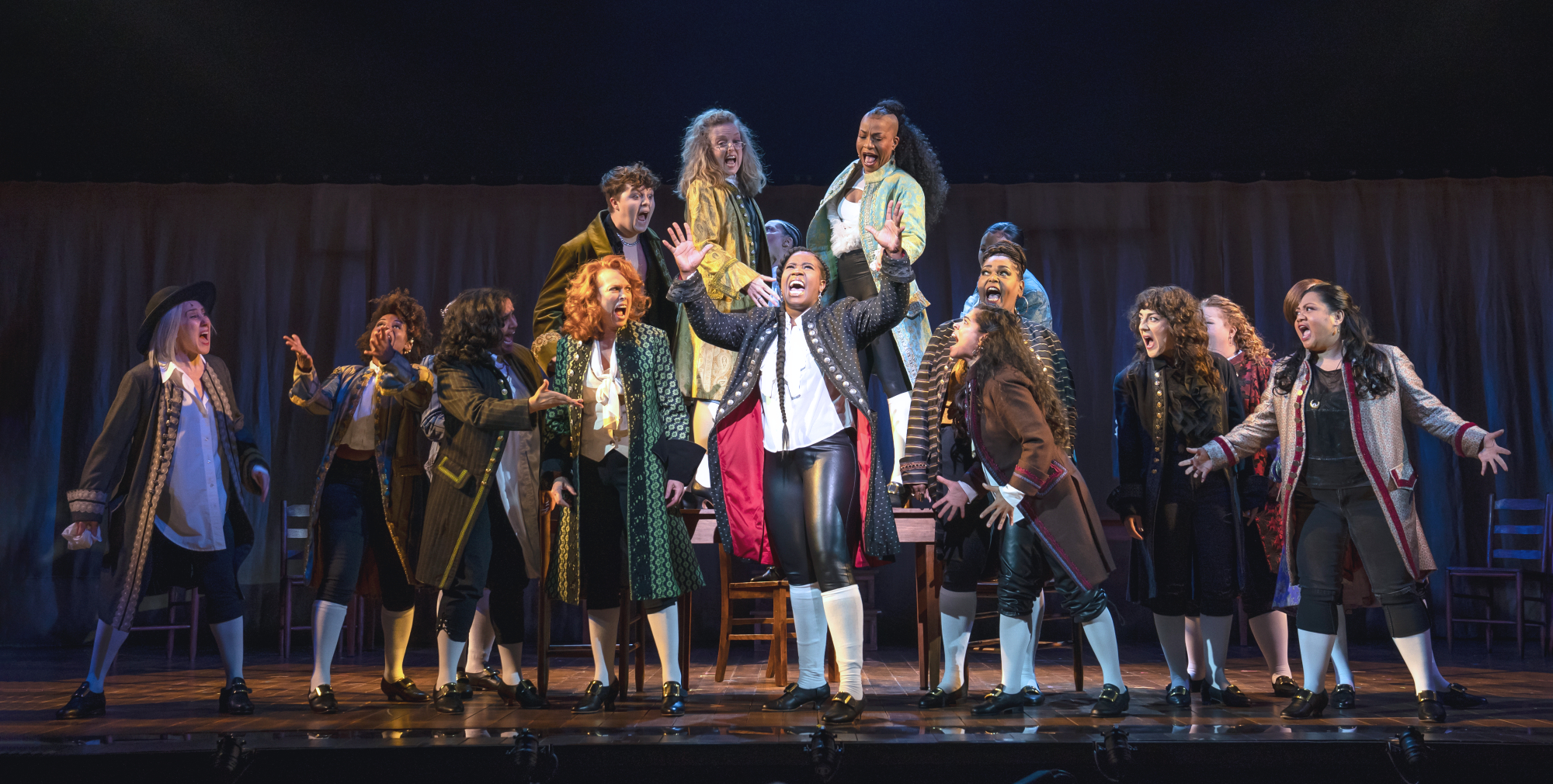
So that’s how we get a Company with a female Bobbie.  Or A Death of a Salesman with a black Loman family.  Or a 1776 with female, non-binary and trans actors portraying the Founding Fathers. Sometimes these new interpretations work. Sometimes they don’t. And I’m sorry to have to say that for me, the production of 1776 that opened this week at Roundabout Theatre Company’s American Airlines Theatre doesn’t.

The story of the contentious days leading up to the signing of the Declaration of Independence on July 4, 1776 and the shameful compromise that was made to get the job done was always a tough challenge for a musical. It’s basically just a bunch of white guys in breeches, waistcoats and perukes yelling at one another. The entire score consists of just 12 songs, with one reprise.

But somehow composer Sherman Edwards and book writer Peter Stone managed to turn all of that into an entertaining—and surprisingly suspenseful—musical that beat out Hair for the Tony in 1969 and ran for 1,217 performances. 

The show has been one of my favorites since I saw the original production from a seat high in the balcony during a spring break from college. And every Fourth of July, I try to watch at least some of the 1972 movie version, which was filmed with almost the entire original Broadway cast, including the invaluable William Daniels balancing just the right mix of sweet and sour as the right-minded but irascible John Adams.

The new 1776 does start off promisingly. All the members of the ensemble—diverse in terms of age, color, ethnicity, gender identity and size—walk onstage wearing various forms of streetwear and then they put on frock coats, take off their footwear, pull up the kind of white knee-length stockings men wore in the 18th century and step into the buckled shoes that have been waiting along the rim of the stage: a clever and clear statement that they are now stepping into the roles of the men who founded this country. 

Alas, the show goes down from there. And that’s mainly because it’s a concept without a cause, failing to make the argument for why those actors are stepping into those shoes. When Hamilton cast black and brown actors as the Founding Fathers, composer Lin-Manuel Miranda and director Thomas Kail made the case that this country also belongs to the people who had been previously disenfranchised by it. 

But Jeffrey L. Page and Diane Paulus, who co-directed this revival of 1776, just have their actors go through the motions of the musical. Their revival was conceived before the coronavirus pandemic but they’ve recently said that they want it to reflect the racial reckoning set off by the murder of George Floyd in 2020 (click here to read one of those interviews).  

That retrofitting has produced a few on-the-nose gestures: the new character of Jefferson’s body slave has been added but given no lines except for an ironic but-not-me head shake when Jefferson talks about all men being created equal; a dance mimics enslaved Africans in chains during “Molasses to Rum,” without bringing any new insights into that song about the slave trade that has always been part of the musical.  

The sense of suspense about whether the quarreling delegates will ever reach an agreement that usually animates the play is also lost. Hell, even the calendar that has traditionally hung on the wall, counting down the days to July 4, is missing here. It’s been replaced by intermittent video projections of dates but they’re too easily forgotten. 

More damaging is the fact that with a few exceptions (Shawna Hamic appropriately hamming it up as South Carolina’s vain delegate Richard Henry Lee, Patrena Murray’s droll take on Benjamin Franklin) the actors don’t do enough with the characters. Crystal Lucas-Perry, who will be leaving the production at the end of the month to join the upcoming Ain't No' Mo," gives too much honey and too little vinegar to her portrayal of John Adams. 

When you add it all up, the enterprise carries the whiff of a middling community theater production. Even Scott Pask’s bare-bones set looks less like a concept than something that was done on a tight budget. And the video projections toward the end of the second act come off as a Hail Mary pass for relevancy.

So a production that should offer smart commentary instead just seems gimmicky. It’s great to see so many female-identifying actors on a stage but 1776 was composed primarily for men’s voices (there are only two female roles—Martha Jefferson and Abigail Adams—in the piece). And the revival stumbles here too. 

There are few more rousing opening numbers than “Sit Down, John,” in which his fellow delegates to the Continental Congress admonish Adams, the pre-eminent but annoying advocate for separation from the British, to stop heckling them. I had hoped that this production would imbue that number with the passionate roar of the pussyhat-wearing participants in the 2017 Women's March. Instead, the song sounded like a track from the 1970s bubblegum band Josie and the Pussycats. 

All of which left me wondering, Why is this show here?


September 24, 2022

Alan Cumming Follows His Passion in "Burn"

The very limited six-day run of Burn, Alan Cumming’s solo performance piece at The Joyce Theater, ends this weekend but there is so much joy in it that I can't resist celebrating it. 

Cumming, who broke out as the emcee in the 1998 revival of Cabaret, has gone on to make a good living doing movies (“Spy Kids,”  “X-Men”) and TV shows (“The Good Wife,” “Instinct”) but he has remained at heart a true artist who is always looking for new ways to express himself.

In 2008, Cumming opened that year’s Lincoln Center summer festival in an exuberant production of the seldom-performed The Bacchae that had him making his entrance by descending, upside-down, from the ceiling. Five years later he turned in an intense performance in a one-man version of Macbeth in which he played all the parts. He’s also written three memoirs and a children’s book, is a co-producer of A Strange Loop and the host of “Club Cumming,” a showcase for queer comedians that is currently streaming on Showtime (click here to check that out).

Now Burn is at the Joyce, the Chelsea venue for dance, because Cumming teamed up with the choreographer Steven Hoggett to create a movement-and-word tribute to the 18th century poet Robert Burns, revered as the national bard of their native Scotland. 

After working on it for nearly seven years, the duo took the piece to the Edinburgh International Festival in August (click here to read about their journey). When word came that they were also bringing it here to New York, my always-up-for-anything theatergoing buddy Bill and I bought tickets to see it.

To be honest, the show is far from perfect. For starters, Cumming is not a trained dancer and, at 57, he often gets winded as he executes the movements that Hoggett and his co-choreographer Vicki Manderson have created for him to perform. The words he speaks are drawn from some of Burns’ poems but more so from the letters that Burns wrote and that reveal more about the man inside the icon. But, alas, some of those words were occasionally drowned out by Anna Meredith’s score, a crazy-quilt fusion of Scottish folk tunes and techno beats.

However in the end, none of that really mattered. Burns, the author of the New Year’s Eve classic “Auld Lang Syne,” is a compelling subject. The son of a poor tenant farmer, he was largely home schooled and spent most of his early years laboring on the farm although he never developed a knack for it and would struggle with making a living until he died at the age of 37. 

Burns began writing mainly as a way to woo girls and he remained lusty throughout his life, siring 12 children, three out of wedlock and the last born on the day of his funeral. But his poems, an innovative mix of Scottish and English wordplay, eventually branched out to deal with such subjects as class inequality, the role of the church in society, the poet's own intermittent bouts of depression and his always abiding love for his homeland. 

Cumming and Hoggett are proud Scotsmen too and both have worked often with the National Theater of Scotland, where they incubated this piece. As always, Hoggett, who has devised distinctive movement for such shows as Once, The Curious Incident of the Dog in the Night-Time and Harry Potter and the Cursed Child, found surprisingly playful and inventive ways to tell Burns' story. 

There were bits of stage magic—a quill pen that writes by itself—and other memorable images: the women in Burns’ life were represented by shoes that dangled from the ceiling on ribbons. Terrific videos by Andrzej Goulding and effective lighting by Tim Lutkin recreated the Scottish landscape and the peaks and valleys inside Burns’ mind. 

And, of course, Cumming was as passionate and committed as ever. He never left the stage during the 60-minute performance and his obvious delight in what he was doing kept the audience right in the palm of his hand. 

As Bill and I stood outside the theater after the show, he said how glad he was to have seen it. Me too.


September 3, 2022

A Labor Day Salute to Stage Managers

Monday is Labor Day, which means that it’s time for my annual tribute to some of the people whose labor makes the theater we all love work. I’ve been doing this for 15 years now and I can’t tell you how embarrassed I am that I’m just getting around to celebrating stage managers, who may be the hardest working people in the business.

Stage managers are the linchpins that connect the creative and technical sides of every production. They make sure that actors don’t forget their cues and that props are where they should be onstage. They run tech rehearsals so that the lighting and sound folks can work out their plans and replacement rehearsals so that newcomers to a production can figure out what they’re supposed to do. They provide a shoulder for everyone from the director to the dressers to cry on. And they gamely—and graciously—shoulder the blame when things go wrong, even when it isn’t their fault (click here to read some specific stories about what they do).

I got some further insight into what it takes to be a good stage manager by reading “Whenever You’re Ready: Nora Polley on Life as a Stratford Festival Stage Manager.” When Polley first started out in the early 1970s as an assistant stage manager at the Ontario-based festival, an old-timer told her “If anybody notices you are doing your job, it’s because you’ve just made a mistake…good stage management is invisible.” 

Over the next four decades, Polley would take that to heart, quietly dealing with everything from doling out breath mints to actors about to engage in an onstage kiss to administering first aid when an actor collapsed in the middle of a scene. And, like her brother and sister stage managers at theaters large and small, doing it all without the glory that comes from being onstage, content to settle for the occasional compliment of “Good show.”

Polley had retired by the time Covid created the unprecedented crisis of closed theaters all over the world. But Richard Hester, a Broadway stage manager who has worked on such shows as Titanic, Sweet Smell of Success and Jersey Boys, swung into action and, in typical stage manager style, kept up the morale of his colleagues in the community with a series of blog posts about how he and they were making it through the pandemic. He’s collected those tales about that darkest time between March 2020 and April 2021 in his new book “Hold, Please: Stage Managing A Pandemic.”

Another thing to come out of the pandemic was the call for greater diversity and inclusion backstage as well as onstage. There have been stage managers of color in the past. My college schoolmate, the great Fémi Sarah Heggie, got her start with the Negro Ensemble Company and was one of the first African-American women to get an Equity card as a stage manager. 

Over the years, Fémi has worked on such Broadway shows as Ain’t Supposed to Die A Natural Death, Jelly’s Last Jam and Once on This Island.  And there have been others, including Lisa Dawn Cave, who has some 20 Broadway credits over the past two decades, including the original production of Caroline, or Change and Shuffle Along. 

But a study conducted by Actors' Equity Association (which represents stage managers as well as actors) revealed that between 2016 and 2019, fewer than 3% percent of the stage managers working on professional productions in the entire country were black (click here to read more about that). And when African Americans do get hired, they tend to get hired primarily for shows by black playwrights or those with largely black casts.

Lately, there have been some more hopeful signs of change.  Both the La Jolla Playhouse in California and the Alliance Theatre in Atlanta have started programs that provide BIPOC fellows with salaries, benefits and the opportunity to work on major (and hopefully not just black) professional productions. 

There’s obviously still a long way to go.  But as we move along, I hope we’ll all take the time to recognize and appreciate the vital work that all stage managers do. In the meantime, I hope they’ll accept this belated salute and my most sincere wishes that they—and you, dear readers—have a Happy Labor Day.


August 13, 2022

"The Butcher Boy" and "On that Day in Amsterdam" May Have Arrived Too Soon

Everyone who loves serious theater loves the idea of giving talented new writers a chance to show what they can do. The question is the timing. Too many workshops (and the notes that come along with them) can leach a show and its creator of the originality that made them special in the first place. But a premature production doesn’t do them any favors either. At least those are the thoughts that popped into my head as I sat through two recent shows by newcomers that have been given full-fledged productions that unfortunately reveal the shortcomings of each.

The first was The Butcher Boy, Asher Muldoon’s musical adaptation of the Irish writer Patrick McCabe’s novel that is now playing at the Irish Rep through Sept. 11. Muldoon, who is about to begin his senior year at Princeton, ambitiosly wrote the book, music and lyrics. But he may have bitten off more than he could chew.

To be fair, McCabe’s unsettling novel would be a mouthful for anyone. Set in the 1960s, it tells the story of a troubled boy named Francie Brady. Francie’s father is an alcoholic. His mother is suicidal. Physical abuse in the home is routine. Francie copes by bullying other kids, committing petty crimes and pretending that his life is fine. 

But when a schoolmate’s mother accuses him and his family of behaving like pigs, Francie spirals into a psychotic state in which he is haunted by the images of people with pig-like faces who prod him to do increasingly horrific things. 

Muldoon takes a literal approach to the tale. In his version, Francie, who frequently breaks the fourth wall to narrate what’s going on, is the only character who is anywhere near fully-realized. The others in the small working-class Irish town where he lives are barely sketched in at all so their actions make little sense. 

And there’s no attempt to provide a reason for telling Francie’s story by connecting it to anything larger than itself. Which leaves us in the audience just waiting for one horrible thing to happen after another. And plenty of them do happen.

The score is a genial but undistinguished mix of Irish folk music, British music hall tunes and generic pop. The lyrics may have been more distinctive but the sound design was so poor that I could barely make them out. The elderly couple behind me cranked their listening devices so high that the audio feedback crackled around us and they still complained at intermission that they couldn’t hear what was being sung either.

According to interviews he’s given, Muldoon was working a front-of-the-house job at the Irish Rep when he showed its artistic director Charlotte Moore and producing director Ciarán O’Reilly his script and they decided to do his show (click here to hear more about that). And under O’Reilly’s direction, the Rep has gone all out with the staging for The Butcher Boy. 

The handsome set is dominated by a giant TV screen on which projected images from the 1960s ranging from Nikita Khrushchev banging his shoe on a desk at the U.N. to Rod Serling introducing episodes of “The Twilight Zone” help set the jittery mood of that era. Meanwhile, the 12-member cast, led by the hardworking Nicholas Barasch as Francie, does the best it can, despite their singing sometimes wandering off-key.

The result is a show that might have been the hit of a college musical writing course or even of a Fringe festival but that instead now comes off as somewhat jejune. 

Clarence Coo, the author of On That Day in Amsterdam, which opened this week in a Primary Stages production at 59E59 Theaters, is older than Muldoon and his play has taken a more traditional route having been workshopped at such theatrical incubators as the Sundance Institute and New York Stage and Film, but the show is still his world premiere as a professional playwright and it too bears the marks of a fledgling pushed out of the nest too soon.

The play has been promoted as the romantic story of two young men who hook up and then spend the following day wandering around the titular city even though each is scheduled to leave town that night. But On That Day in Amsterdam wants to be more than that. One of the men, Sammy, is a refugee who has fled his Middle Eastern homeland and is about to end what has already been an arduous journey by being smuggled into London. The other, Kevin, is an American college kid traveling through Europe on his mother’s purloined credit card. 

Coo clearly wants to compare the restrictions and privileges their backgrounds place on each man but he undercuts that with meditations on art, detours into the lives of Rembrandt, Vincent van Gogh and Anne Frank and a travelogue of the city; just about every museum there gets name checked.

It’s difficult to dramatize all of that in 90 minutes and so Coo falls back on having his characters narrate the story instead of performing it. Director Zi Alikhan, who describes himself  as “a queer, first-generation South Asian-American, culturally Muslim theater Director” would seem to be the perfect person to stage this show. But instead of drawing me into the narrative, many of Alikhan's decisions pushed me out of it.  

The story is framed as a book that Kevin is trying to write about his brief time with Sammy and so I’m guessing that placing most of the action behind a scrim is supposed to suggest the gauziness of his memory but instead it just creates a barrier between the players and the audience. 

Similarly projecting close-ups of the actors’ faces on the scrim doesn't create an intimacy with them but is as off-putting as when Ivo van Hove did the same thing in his revival of West Side Story.  

Neither Muldoon nor especially Coo, who has won such prestigious honors as the Whiting Award for emerging writers and the Yale Drama Series Prize, is untalented. So I’m hoping they’ll continue to develop their talent and that when the time is right, someone will give them another chance to show what they can truly do.